
FANCL Group has created an internal control system as a mechanism to ensure the efficacy and efficiency of operations, the reliability of financial reports, and compliance with laws an regulations. The FANCL Management Strategy Committee is positioned as the highest-level decision-making body within the FANCL Group, with the Group Risk and Compliance Committee positioned as a subordinate body. Once a year, a review is conducted by these committees/conference bodies and related divisions, to identify "business and other risks," which are then decided upon by the FANCL Management Strategy Committee. The FANCL Management Strategy Committee reviews the measures taken to address the risks, verifying the feasibility of the measures, and taking further actions with regard to risks that have not been resolved.
Group Risk and Compliance Committee
We have established the Quality Control Working Group, Compliance Working Group, Internal Control Working Group (Financial and IT Controls), and IT Security Working Group as task forces under the Group Risk and Compliance Committee. Each Working Group analyzes and considers countermeasures for risks including changes in physical condition when using Group products, violations of laws and regulations within Group operations, and matters pertaining to quality assurance, finance and accounting, personal information and trade secret management, laws and regulations, legal action, bribery, and information security. Their findings concerning risk analysis, risk response, and the status of legal compliance are reported to the FANCL Management Strategy Committee by the Group Risk Compliance Committee through two regular reports per year, as well as when necessary.
BCP (Business Continuity Plan)
Drawing on the lessons learned from the Great East Japan Earthquake, FANCL Group formulated a Business Continuity Plan (BCP) to minimize potential damage and enable the delivery products to customers as quickly as possible in the event of an earthquake directly under the Tokyo metropolitan area, which is predicted to have a significant impact on our business. However, in addition to earthquakes, in recent years other disasters have been increasing year by year, including windstorms and floods, infectious diseases such as COVID-19, and IT failures caused by cyberattacks, and the damage has become increasingly significant. In light of this situation, from 2021 we have working to restructure our BCP to cover our response to all types of potential hazards.
Across our production facilities, we have launched a cross-functional initiative spanning six sites in Japan. Alongside our core products, we are establishing a system that enables multiple locations to produce goods that support disaster victims, while also developing rapid recovery plans for facilities impacted by disasters to ensure preparedness for unforeseen events.
Across the Group, we regularly review initial response measures in the event of a disaster and recovery plans aimed at ensuring business continuity, and we strive to enhance their effectiveness through BCP drills.
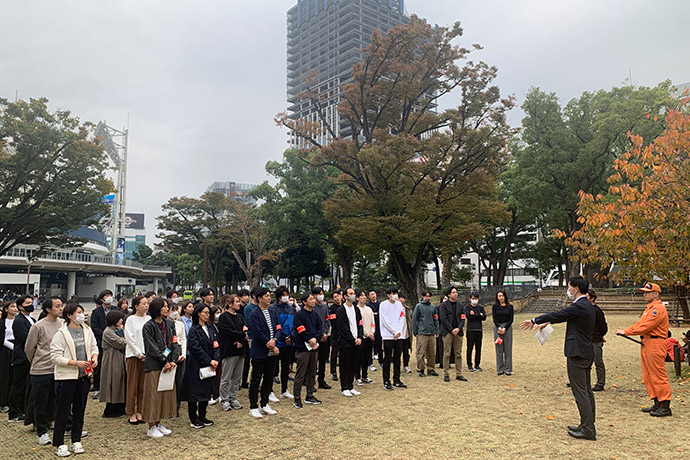
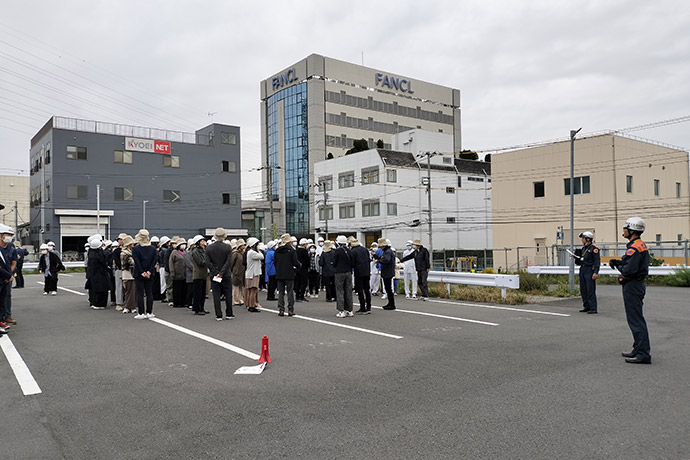
A scene of an evacuation drill