We aim to build coexistence and coprosperity with trading partners in accordance with the FANCL Group Sustainable Procurement Policy in order to realize sustainable procurement that is considerate of the environment, human rights, and labor issues.
Initiative report
Anti-corruption initiatives
The FANCL Group Sustainable Procurement Policy sets forth basic rules for relationships with suppliers, and the FANCL Group Trading Partner (Supplier) Code includes an anti-corruption clause to ensure that all suppliers are fully aware of these rules.
When negotiating an agreement with a new trading partner, we first carry out an onsite inspection and then confirm that it will comply with the FANCL Group Trading Partner (Supplier) Code before concluding the agreement. We also carry out regular surveys and interviews with existing trading partners to check their status regarding compliance with the procurement policy.
Collaborating with trading partners on sustainable procurement
Responsible sustainable procurement requires close collaboration with our trading partners. The FANCL Group has been working together with trading partners to gradually advance these initiatives.
Leveraging Sedex, which we joined in June 2023, we will centrally manage information related to environmental, human rights, and labor practices across our supply chain. By encouraging our business partners to also join Sedex, we aim to expand this information network and build a system that enables the identification, assessment, and analysis of risks across the supply chain.
- January 2020
- We conducted a questionnaire with about 100 suppliers regarding the status of their sustainable procurement initiatives.
- January 2021
- We revised the FANCL Sustainable Procurement Policy.
We formulated the Trading Partner (Supplier) Guidelines and sent these to approximately 2,200 suppliers. - October 2022
- We conducted a survey of 458 suppliers on their compliance with our Trading Partner (Supplier) Guidelines.
- April to June 2023
- We interviewed some suppliers based on the results of this survey.
- June 2023
- Sedex※Membership
- From October 2023
- Began interviews with valued trading partners to gauge interest in joining Sedex
- May 2025
- We have revised the FANCL Group Sustainable Procurement Policy and the FANCL Group Trading Partner (Supplier) Code※ and communicated these updates to trading partners
Renamed from the Business Partner (Supplier) Guidelines
- From September 2025
- Initiated dialogue with business partners based on their responses to the Sedex SAQ (Self-Assessment Questionnaire)
Sedex is a reporting platform for sharing and verifying information on labor standards, health and safety, the environment, and business ethics, to promote responsible business practices in the supply chain.
Human rights due diligence in supply chains
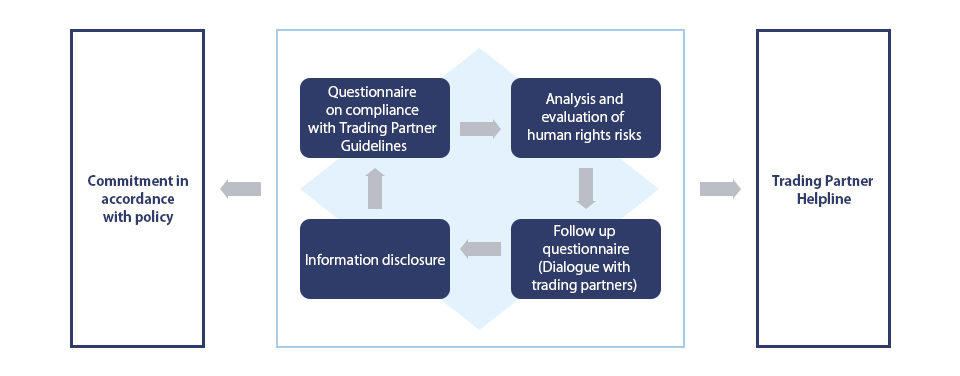
To fulfill our responsibility to ensure that the human rights of all people involved our supply chains are respected, the FANCL Group Sustainable Procurement Policy and the FANCL Group Trading Partner (Supplier) Code stipulate respect for human rights in supply chains. We have established mechanisms to respond to human rights risk in accordance with the UN's Guiding Principles on Business and Human Rights, and if we identify any way in which the Group might negatively impact the human rights of anyone in society, we work to prevent or mitigate this impact. When opening discussions with a new trading partner, we inform them of the FANCL Group Trading Partner (Supplier) Code in advance and do not start trading until they have agreed to comply with the guidelines. We have also established the Trading Partner Helpline (FANCL Hotline) to handle complaints and reports from trading partners, and we work to build and maintain fair and equitable relationships with all of our trading partners.
Click here for more information on the Trading Partner Helpline (FANCL Hotline)
Sustainable palm oil procurement in collaboration with trading partners
The procurement of raw materials is accompanied by various environmental and social issues, including human rights violations such as forced or child labor.
The FANCL has positioned palm oil as a high-risk material, so we have made it a priority to share these issues with trading partners who supply the palm oil used in our mainstay product Mild Cleansing Oil and to work with them on switching to RSPO※-certified oil. We are steadily switching the palm oil used in our business to RSPO-certified oil based on the understanding of our trading partners.
- Roundtable on Sustainable Palm Oil
Click here for more information on the Procurement of sustainable palm oil